
An ingrown toenail caught early usually settles down with warm soaks, roomy shoes, and a few days of patience. Once there’s pus, once the same toe has done this three times, or if you have diabetes, home care stops being the answer and starts being a delay.
The difficulty is that most advice online treats every ingrown nail the same way. They aren’t the same. A red, tender edge and a toe with granulation tissue growing over the nail need completely different things.
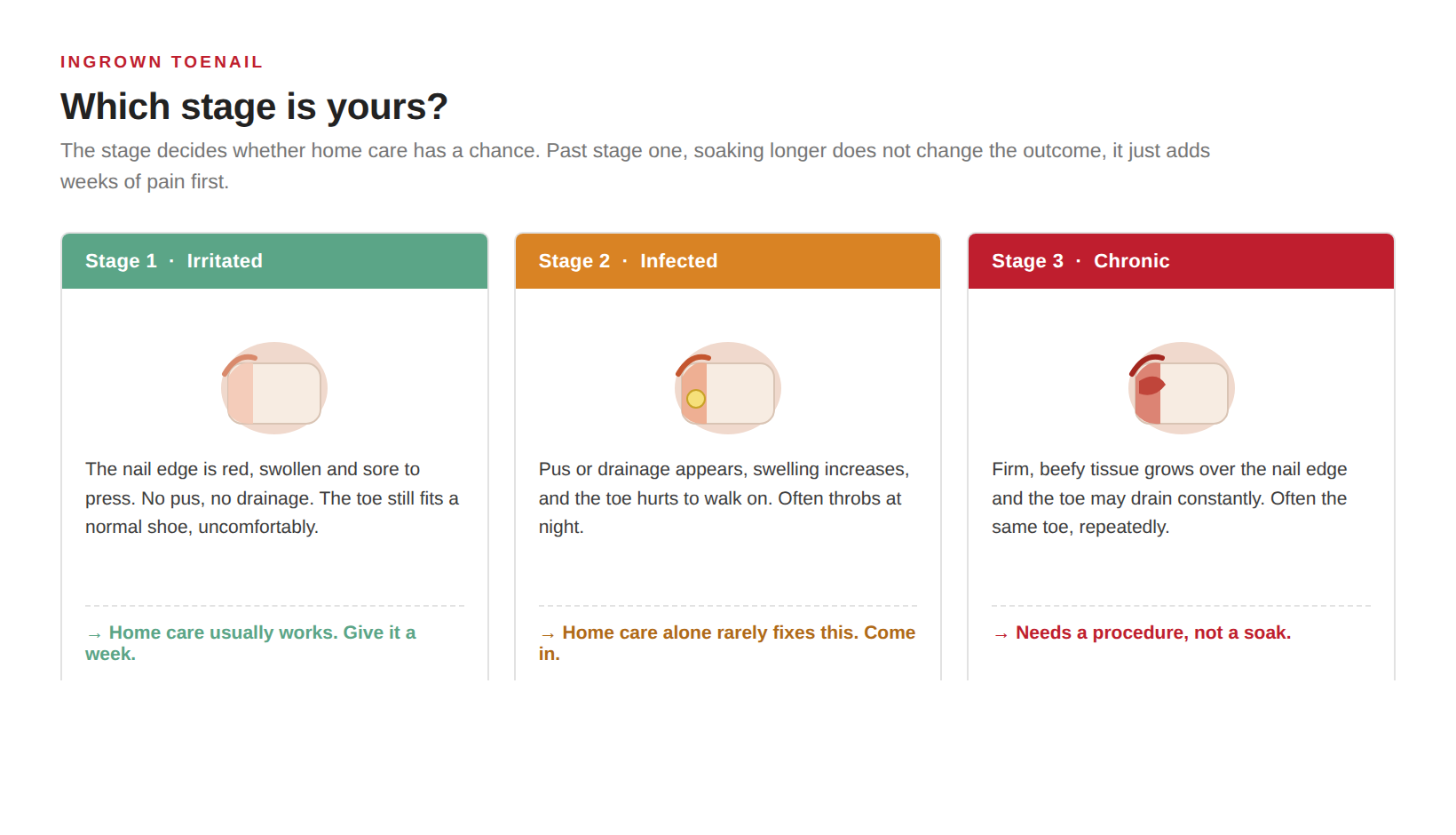
Which stage is yours?
Clinicians usually sort ingrown nails into three rough stages, and the stage tells you whether home care has a chance.
- Stage one: the edge of the nail is red, swollen and sore to press. No pus, no drainage. Home care usually works here.
- Stage two: drainage or pus appears, the swelling increases, and the toe is painful to walk on. Home care alone rarely resolves this one.
- Stage three: firm, beefy tissue starts growing over the nail edge, and the toe may drain constantly. This needs a procedure, not a soak.
If you’re past stage one, soaking longer isn’t going to change the outcome. It just adds weeks of pain first.
What doesn’t work, and what makes it worse
A few things circulate widely online that are either useless or actively harmful.
- Digging the nail out yourself. This is the single most common reason a minor ingrown nail turns into an infected one. You cannot see the nail edge under the skin, and the instrument isn’t sterile.
- Cutting a V or a notch in the middle of the nail. It does nothing. Nails don’t grow sideways toward a notch.
- Vicks, hydrogen peroxide, and rubbing alcohol. None of them change how a nail grows. Peroxide and alcohol damage healing tissue on top of it.
- Stuffing cotton under the nail for weeks. Lifting the edge can help briefly, but packed cotton left in place holds moisture and bacteria against exactly the spot you’re trying to settle down.
Antibiotic ointment is fine on the surface and won’t do any harm. It also won’t fix a nail that’s growing into skin, because the problem is mechanical.
If you have diabetes or numbness in your feet, skip the home care
This is the part worth stopping on. If you have diabetes, neuropathy, or poor circulation, an ingrown toenail is not a minor nuisance to manage at home.
You may not feel the infection progressing. Reduced blood flow means it heals slower and spreads faster. What is a sore toe for one patient becomes a serious foot infection for another, and the gap between those two outcomes is often just a couple of weeks of waiting it out.
Come in early rather than late. Treating a small problem in a high-risk foot is straightforward. Our wound care and limb salvage team spends a great deal of time on infections that started as something small.
Why it happened in the first place
Ingrown nails are usually mechanical rather than bad luck, and knowing the cause tells you whether it will happen again.
- Trimming the corners down and back, which leaves a spike of nail under the skin fold as it grows out
- Cutting nails too short, so the skin at the tip rolls over the advancing edge
- Shoes that squeeze the toe box, including running shoes half a size too small
- Repeated impact from running, hiking downhill, or court sports
- A nail that is naturally curved from side to side, which is inherited and is the usual reason someone gets these over and over
- A stubbed toe or a dropped object, which changes how the nail grows back
If yours came from a trimming habit or a tight shoe, fixing that may be the whole solution. If your nails are strongly curved by nature, no amount of careful trimming changes the shape, which is why those are the ones that keep returning.
One more thing worth ruling out. Not every painful nail edge is ingrown. Fungal thickening, a wart alongside the nail, and an old injury that deformed the nail plate all get mistaken for one, and they need different treatment. If soaking has done nothing and the nail looks discolored or thickened, that’s worth a look rather than another week of Epsom salts.
What we do in the office
Most ingrown nails are handled in a single visit under local anesthetic. The toe is numbed, the offending edge of the nail is removed, and you walk out. The relief is usually immediate, and most people are surprised how quick it is.
For a nail that keeps coming back, removing the edge again just restarts the clock. In that case the border of the nail can be treated permanently so that strip never regrows. The nail looks slightly narrower afterward and most people never think about it again.
When to come in without waiting a week
- Pus, or drainage of any kind
- Redness spreading up the toe or into the foot
- Fever, or red streaks moving away from the toe
- Diabetes, neuropathy, or circulation problems, regardless of how it looks
- A toe that has done this repeatedly
- Pain bad enough that you’re changing how you walk
Common questions about ingrown toenails
Will an ingrown toenail eventually grow out on its own?
Sometimes, if it’s mild and you change the shoes and the nail trimming habits that caused it. If the nail edge has already broken the skin, it usually doesn’t resolve on its own, because the nail keeps growing into the same spot.
Is it okay to dig out an ingrown toenail myself?
No. It’s the most reliable way to turn a sore toe into an infected one. If the nail edge does need to come out, it takes two minutes with a numb toe and sterile instruments.
Can an ingrown toenail cause a serious infection?
It can. Most don’t, and in an otherwise healthy person a treated ingrown nail is a minor problem. But an untreated infected toe can spread into the deeper tissue and bone, and that risk is considerably higher for anyone with diabetes or poor circulation. That’s the reason to treat it rather than tolerate it.
How long does it take to heal?
A mild one settles in a week or so with home care. After an in-office procedure, most people are comfortable within a couple of days and fully healed in two to four weeks, depending on whether the border was treated permanently.
How do I stop it happening again?
Trim nails straight across rather than curved down at the corners, don’t cut them too short, and wear shoes that don’t press on the toe box. If it keeps recurring despite that, the shape of your nail is the cause and a permanent correction is the fix.
You don’t need to live with it
Most people wait far longer than they need to on a toe that takes one visit to sort out. If it’s sore enough that you’re reading about it, it’s sore enough to look at.
Our surgeons see patients in Oklahoma City and Tulsa, with clinics across Oklahoma. Request an appointment or call the office closest to you.