Most of what happens in the first weeks after foot surgery is uncomfortable and completely expected. A smaller set of things is not, and those need acting on quickly rather than waiting for your next appointment.
The short version: call 911 for chest pain or sudden shortness of breath. Call us the same day for fever, spreading redness, foul drainage, pain that is climbing rather than easing, calf pain or swelling, or toes that turn pale, blue, or numb. Everything else can usually wait for office hours.
Go to the emergency room or call 911
- Sudden shortness of breath
- Chest pain, or pain when you breathe in
- Coughing up blood
- Fainting, or a racing heart with breathlessness
These can indicate a blood clot that has travelled to the lungs. This is the one situation after foot surgery where you should not call the office first.
Call the office the same day
Signs of infection
- A temperature over 100.4°F
- Redness spreading outward from the incision, rather than a thin pink line at its edge
- Warmth in the area that is increasing rather than settling
- Drainage that is thick, cloudy, yellow or green, or that smells bad
- Pain that gets worse after day three or four instead of better
- Chills, or feeling generally unwell
Infections after foot surgery are uncommon and very treatable when caught early. Caught late they can involve the bone, which turns a course of antibiotics into a much longer problem. Early is better in every case, and nobody here minds a call that turns out to be nothing.
Signs of a blood clot in the leg
- Pain, cramping, or tenderness in the calf, especially in one leg only
- New or worsening swelling in the calf rather than in the foot
- Warmth or redness in the calf
- A calf that feels tight or firm compared with the other side
Foot and ankle surgery carries a real risk of clots because the leg is immobilized. Calf symptoms are different from the foot swelling you were told to expect, and the difference is the location. Foot and ankle swelling is normal. Calf swelling is a phone call.
Circulation and nerve problems
- Toes that look pale, white, blue, or dark
- Toes that feel cold compared with the other foot
- New numbness, or a burning sensation that is spreading
- Being unable to move or wiggle your toes when you could before
- A cast or dressing that feels progressively tighter
A dressing that becomes too tight as the foot swells can restrict circulation. If your toes change color or sensation and the dressing feels constricting, that is a same-day call and not something to loosen yourself.
Wound and hardware problems
- The incision opening, or edges separating
- A stitch or a piece of hardware coming through the skin
- Bleeding that soaks through a dressing rather than spotting it
- A fall onto the operated foot, or a pop followed by a change in the shape of the foot
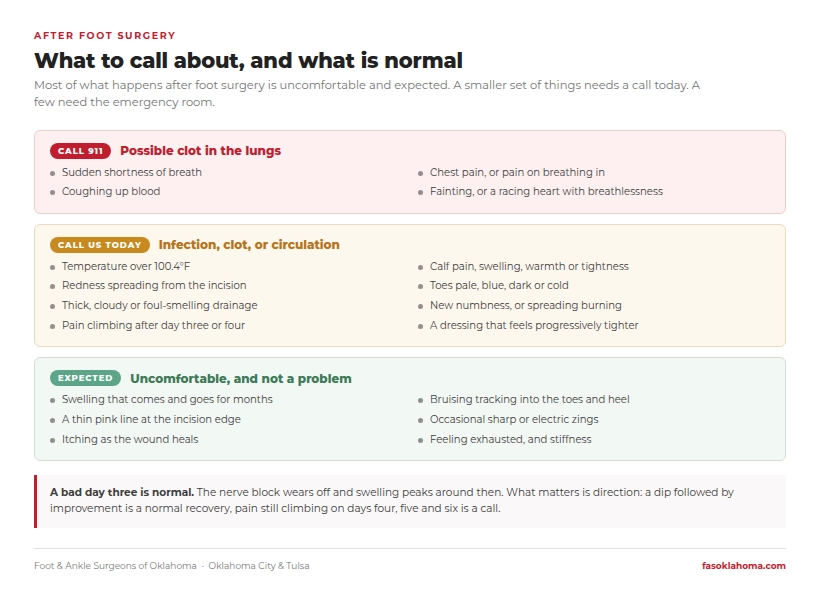
What is normal, and not a reason to worry
Patients call about these constantly, and in almost every case the answer is that it is expected.
- Swelling. It is the defining feature of foot surgery recovery and it can come and go for six months to a year. It gets worse when the foot is down and better when it is up.
- Bruising that spreads. Blood tracks with gravity, so bruising appearing in the toes, the heel, or around the ankle days after surgery is normal even though it looks alarming.
- A thin pink line at the edge of the incision. Redness that stays put and does not spread is part of healing.
- Clear or slightly blood-tinged drainage in the first days. Volume should decrease, not increase.
- Itching around the incision as it heals.
- Occasional sharp, shooting, or electric sensations. Small nerve branches are disturbed during surgery and complain as they recover. Brief zings that come and go are normal; constant numbness that spreads is not.
- Feeling exhausted. Anesthetic, disturbed sleep, and moving on crutches all cost more energy than people expect.
- Stiffness in the toes and ankle after immobilization.
Why day three is often the worst
A lot of people expect to feel steadily better from the moment they get home and are caught out around day two or three. Two things are happening. The nerve block or long-acting local anesthetic from surgery is wearing off, and swelling typically peaks in this window.
So a day-three dip is common and expected. What separates it from a problem is direction. A bad day three followed by improvement is a normal recovery. Pain that keeps climbing through days four, five, and six is the pattern that needs a call.
What actually happens when you call
This is the part that stops people picking up the phone, so it needs spelling out.
During office hours you will speak to clinical staff who will ask what you are seeing, how long it has been going on, and what your temperature is. Most calls are resolved on the phone with reassurance or an adjustment to what you are doing. Some result in being asked to come in that day, usually so we can look at the incision. A few result in a prescription.
Nobody is inconvenienced by a call that turns out to be normal swelling. Surgeons would far rather answer ten of those than miss one early infection, and post-operative calls are an expected part of caring for a surgical patient rather than an imposition on it.
It helps to have your temperature, a photograph of the incision taken in good light, and the date of your surgery ready when you call.
Reducing the risk before it becomes a warning sign
- Keep the foot elevated above heart level as instructed. Uncontrolled early swelling makes wound problems more likely and everything else slower.
- Keep the dressing dry and intact. Do not remove it to look unless you have been told you can.
- Move your toes and do any ankle movement you have been cleared for. Movement is the simplest thing you can do to reduce clot risk.
- Stay hydrated and get up to move as much as your restrictions allow.
- Take any prescribed blood thinner exactly as directed. If you were not prescribed one and you have a history of clots, make sure your surgeon knows.
- Do not smoke. It measurably slows bone and wound healing and raises the infection risk.
- If you are diabetic, keep glucose controlled. Elevated blood sugar impairs wound healing directly.
Common questions after foot surgery
Is sharp, shooting pain in my foot after surgery normal?
Brief electric or shooting sensations are common as small nerves recover, particularly in the first weeks and often when you first put the foot down. They should be occasional and getting less frequent. Constant burning, spreading numbness, or a loss of toe movement is different and should be reported.
How do I tell normal swelling from a blood clot?
Location. Swelling in the foot and around the ankle that improves with elevation is expected. Pain, swelling, tightness, or warmth in the calf, particularly on one side, is not, and that is a same-day call.
How much drainage is too much?
A small amount of clear or pink fluid in the first days is normal and should decrease. Drainage that increases, soaks through dressings, turns thick or cloudy, or develops an odour needs to be looked at.
When should I worry about a fever?
A temperature over 100.4°F should be reported. A slightly raised temperature in the first day or two after surgery is common, but anything above that threshold, or any fever with chills or with redness at the incision, is a call.
How long does it take to walk normally after foot surgery?
It depends entirely on the procedure. Many people walk without aids somewhere between six and twelve weeks and walk without thinking about it around three months. Your surgeon’s schedule for your specific operation is the one that matters.
Should I call if I am not sure?
Yes. If you are asking the question at all, that is a good enough reason. It costs a phone call and it is the entire point of having a surgical team.
When in doubt, call us
You will not be the first person to call about something that turned out to be ordinary swelling, and you will not be an inconvenience. Catching the small number of real problems early is exactly why we ask you to.
Our surgeons see patients in Oklahoma City and Tulsa, with clinics across Oklahoma. Call the office closest to you, or request an appointment.