
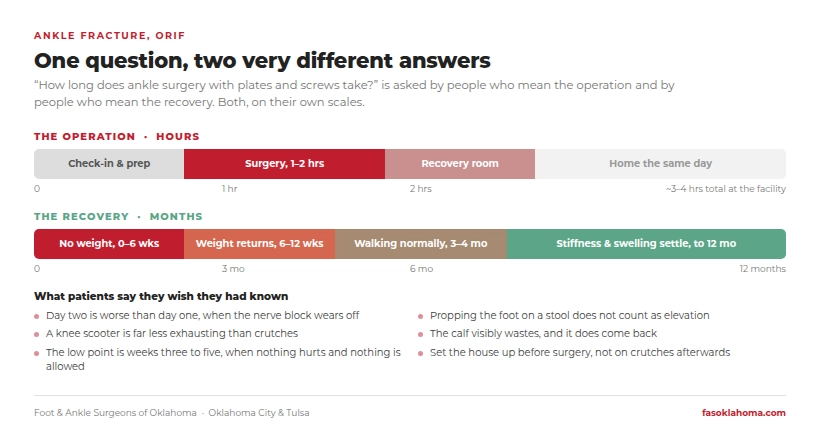
The operation itself usually takes one to two hours. Expect to be at the surgery centre or hospital for around three to four hours in total once check-in, anesthesia, and recovery-room time are counted, and most people go home the same day.
Recovery is the longer answer. Roughly six weeks before weight goes through the ankle, twelve weeks before the bone is solid, and somewhere between six months and a year before the ankle feels like your own again. People searching this question usually want both answers, so both are below.
What the operation is called
Open reduction and internal fixation, shortened to ORIF. Open reduction means the surgeon makes an incision and lines the broken bone up directly rather than manipulating it from outside. Internal fixation means the alignment is held with plates and screws while the bone heals.
The hardware is usually titanium or stainless steel. It is not a repair in the sense of replacing anything. It is a scaffold that holds the bone still, because bone heals reliably when it is held still and unreliably when it is not.
How long the surgery takes
One to two hours of operating time for most ankle fractures. A more complex fracture, one involving several bones or the joint surface, or one that also needs the syndesmosis stabilised, takes longer.
Your total day is longer than the operation. Arrival and check-in, anesthesia, the procedure, and then an hour or two in recovery before discharge. Plan for most of a day and arrange a ride, because you cannot drive yourself home after anesthesia.
Anesthesia is usually general, often combined with a regional nerve block that numbs the leg for the first twelve to twenty-four hours. That block is why many people are surprised by how comfortable they feel the first evening, and why the second day can be a jolt when it wears off.
How painful is it
Honest answer: the first three to five days are properly painful, and then it improves noticeably. The worst window for most people is the twenty-four hours after the nerve block wears off, which usually falls on day one or day two.
Pain is managed with medication, ice, and elevation, and elevation does more than people expect. Most patients are off stronger pain medication within a week to ten days and managing with over-the-counter medication after that.
Aching with weather changes, and soreness at the end of a long day, can persist for a year or more. That is common and not a sign something has gone wrong.
Weeks 0 to 2: elevation and the first check
You will be in a splint or cast, non-weight-bearing, using crutches, a knee scooter, or a walker. The foot needs to be above heart level for most of the day.
Stitches or staples usually come out around ten days to two weeks, and you will have X-rays to confirm the alignment has held. Many people move from a splint into a boot or a cast at this visit.
Weeks 2 to 6: the long part
Still no weight through the ankle in most cases, and this is the stretch people find hardest. The pain is largely gone, the restriction is not, and there is not much to show for the passing weeks.
Some surgeons allow gentle ankle motion out of the boot during this window to limit stiffness. Others keep the ankle immobilized, particularly where the fracture pattern or the fixation is less stable. Both approaches are legitimate and yours will depend on your fracture.
Weeks 6 to 12: weight, and then walking
Around six weeks, X-rays usually show enough healing to begin putting weight through the ankle. This is progressive rather than immediate. Partial weight in the boot, building up over two to three weeks, then out of the boot into a supportive shoe.
The first steps are strange. The ankle is stiff, the calf has visibly wasted, and the leg feels unreliable. All three are expected and all three improve. Physical therapy usually starts here and does most of the work of the recovery.
By twelve weeks the bone is generally healed. Walking without a limp usually arrives somewhere between three and four months rather than at the moment weight-bearing is allowed.
Months 3 to 12: the rest of it
Stiffness and swelling take considerably longer to resolve than the fracture does. End-of-day swelling at six months is normal. Running and impact sport typically wait until at least four to six months and until your surgeon clears you.
Most people get back to what they did before. Some are left with a permanently slightly stiffer ankle, particularly after fractures that involved the joint surface, and some develop arthritis in that ankle years later. Both are more likely with more severe fractures rather than with the surgery itself.
Do the plates and screws come out
Usually not. Hardware is generally left in place permanently unless it causes a problem.
The most common reason for removal is irritation, particularly from plates on the outside of the ankle where the skin is thin and shoes or boots rub. Some people also have hardware removed because of stiffness or discomfort with certain movements. Removal is a smaller operation than the original, but it is still an operation, and it is not done before the bone is fully healed, generally at least a year.
One specific case is different: a screw placed across the syndesmosis, the joint between the two lower leg bones, is sometimes removed or allowed to break by design, because it holds together a joint that is supposed to have slight movement. If you have one, your surgeon will tell you the plan for it.
Airport security is a common worry and rarely an issue. Modern hardware does not usually trigger detectors, and you do not need a card or a letter.
What people say they wish they had known
- That the second day is worse than the first, because of the block wearing off. Knowing that in advance changes it from alarming to expected.
- How much elevation actually matters, and that propping the foot on a stool does not count.
- How exhausting crutches are, and that a knee scooter is easier for most people in most homes.
- That the calf wastes visibly, and that it comes back.
- That the emotional low point is around week three to five, when the pain has gone but nothing is allowed yet.
- How long swelling lasts. Months, not weeks.
- That arranging the house, the bathroom, and the sleeping setup before surgery is far easier than doing it on crutches afterwards.
When to call us
- Pain that is increasing after the first few days instead of easing
- Redness spreading from the incision, or drainage that is thick, cloudy, or foul-smelling
- A fever over 100.4°F
- Calf pain, calf swelling, or new shortness of breath, which can indicate a blood clot
- Numbness, or toes that look pale or blue, or a cast that feels progressively tighter
- A fall onto the operated leg, or a sudden change in the shape or position of the ankle
Our guide to warning signs after foot surgery covers each of these in more detail.
Common questions about ankle surgery with plates and screws
How long does ankle surgery with plates and screws take?
One to two hours of operating time for most ankle fractures, and around three to four hours at the facility in total. Complex fractures involving several bones or the joint surface take longer.
Is ankle surgery major or minor?
It is major surgery in the sense that it involves general anesthesia, an incision, implanted hardware, and a recovery measured in months. It is routine in the sense that it is one of the most commonly performed orthopaedic procedures and is usually done as a same-day operation.
Can I walk after six weeks of ankle surgery?
Many people begin putting weight through the ankle around six weeks, in a boot and building up gradually. That is not the same as walking normally, which usually arrives closer to three to four months.
How long is bed rest after ankle surgery?
There is no period of true bed rest. You will be up on crutches or a scooter from the first day. What is required is that the foot spends most of the first two weeks elevated above heart level, which means a lot of time lying down but is not the same as being confined to bed.
When can I drive?
For a right ankle, generally not until you are out of the boot, off narcotic pain medication, and able to brake in an emergency, commonly around eight to ten weeks. A left ankle in an automatic car is often considerably sooner. Confirm with your surgeon and check your insurer’s position.
Will I set off airport security?
Usually not. Modern implants rarely trigger detectors, and you do not need documentation. If a detector is triggered, telling the officer you have hardware is enough.
Will I get arthritis in that ankle?
There is an increased risk, and it is driven mainly by how badly the joint surface was damaged in the original injury rather than by the surgery. Fractures that did not involve the joint surface carry a much lower risk.
Talk to us about your specific fracture
Ankle fractures vary enormously, and the recovery attached to yours depends on which bones broke, whether the joint surface was involved, and how the fixation went. General timelines are useful for planning and no substitute for the plan your surgeon gives you.
Our surgeons see patients in Oklahoma City and Tulsa, with clinics across Oklahoma. Request an appointment or call the office closest to you.