
Both operations treat the same problem, which is an ankle joint destroyed by arthritis, and both work. Fusion locks the joint permanently and trades motion for a durable, stable, pain-free ankle. Replacement fits an artificial joint that preserves motion but has a lifespan and may eventually need revising.
The procedural comparison is covered well elsewhere. What is harder to find, and what patients actually search for, is what each one is like to live with five and ten years later. That is most of what follows.
What each operation does
Ankle fusion (arthrodesis)
The surgeon removes the remaining damaged cartilage and compresses the tibia against the talus, holding them together with screws, plates, or a rod until they heal into a single bone. Once fused, the joint cannot move and cannot hurt, because the surfaces that were grinding against each other no longer exist as separate surfaces.
Total ankle replacement (arthroplasty)
The damaged joint surfaces are removed and replaced with metal components and a plastic bearing between them. The ankle keeps its up-and-down motion. The implant is a mechanical device with a service life, and the surrounding bone has to support it.
Living with a fused ankle
This is the section the procedure pages tend to skip, and it is the honest core of the decision.
Can you walk normally?
Most people walk well enough that others do not notice. The ankle joint itself no longer flexes up and down, so the foot’s other joints take over some of that motion. On flat ground this works better than it sounds. Many fusion patients describe walking as essentially normal within a year.
Stairs, slopes and uneven ground
This is where a fusion is noticeable. Going down stairs and walking on slopes or uneven ground both require the ankle to adjust its angle, and a fused ankle cannot. Most people adapt by taking stairs one at a time initially and by placing their feet more deliberately on rough ground. It becomes automatic rather than remaining a conscious effort.
Shoes
Heel height matters more than it used to, because the ankle can no longer accommodate a change in it. Most people settle on a consistent heel height and stay with it. A small heel is often more comfortable than completely flat.
Driving, kneeling, and daily life
Driving is usually straightforward, particularly for a left fusion in an automatic car. A right fusion is manageable for most people once recovered. Kneeling with the foot flexed under you becomes difficult or impossible, which matters if you garden, lay flooring, or pray in a kneeling posture.
What happens at ten years
The specific concern with fusion is that the joints around the fused ankle absorb the motion it no longer provides, and over years that can produce arthritis in those joints, usually in the hindfoot. It does not happen to everyone and it does not always cause symptoms when it does. When it does become painful, treatment options include further fusion of the affected joints.
Against that, a well-healed fusion is durable. It does not wear out, and it does not need replacing on a schedule. Many fusion patients go decades without further surgery.
Is ongoing pain normal?
Some aching, particularly with weather changes or at the end of a long day, is common and not a sign of failure. Pain that is still significant at six months, or pain that returns after a good period, should be investigated. The main causes are a fusion that has not fully united, hardware irritation, or arthritis developing in a neighbouring joint.
Living with a replaced ankle
Motion, and what it is worth
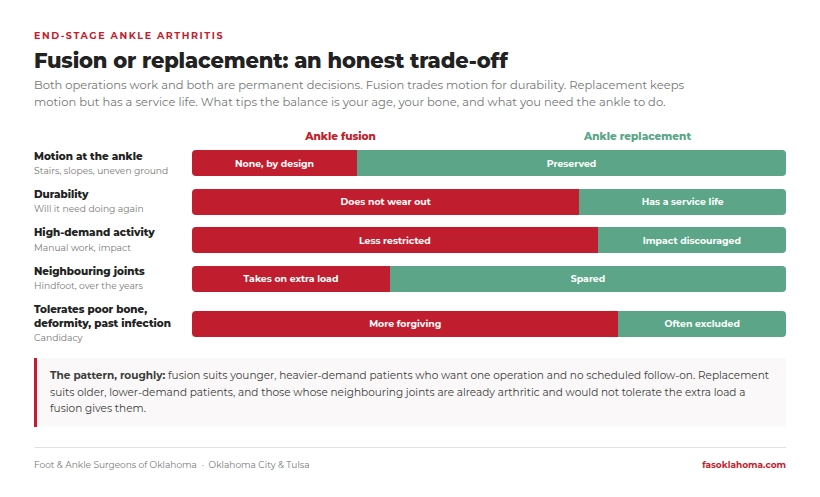
A replacement preserves up-and-down motion, which makes stairs, slopes and uneven ground easier than a fusion does, and produces a more natural walking pattern. It also spares the neighbouring joints the extra work a fusion gives them, which is the main long-term argument for it.
The lifespan question
An ankle replacement is a mechanical implant and it does not last forever. Designs and results have improved substantially, and current implants perform considerably better than the early generations that gave ankle replacement a poor reputation decades ago. Even so, a proportion will need revision, and the younger and more active you are at the time of surgery, the more likely that becomes within your lifetime.
Revision is a bigger operation than the original. Where a replacement cannot be revised, conversion to a fusion is usually possible, though it is a more complex fusion than a primary one would have been.
Activity limits
Walking, swimming, cycling, golf, and hiking on reasonable ground are generally fine. Running and impact sports are usually discouraged because they accelerate wear. Fusion patients are, if anything, less restricted in high-impact activity, which surprises people.
Who each operation tends to suit
Fusion tends to suit
- Younger and more active patients, where implant longevity is the main concern
- Heavy manual work, or work on ladders, scaffolding and uneven ground
- Significant deformity, poor bone quality, or previous infection in the joint
- Damage to the ligaments that a replacement would need to stay stable
- Diabetes with neuropathy, or other conditions affecting the reliability of an implant
- Patients who want one operation and no scheduled follow-on
Replacement tends to suit
- Older, lower-demand patients where implant lifespan is less likely to be tested
- Arthritis already present in the joints around the ankle, which a fusion would load further
- An already fused or arthritic ankle on the opposite side, where preserving motion on one side matters more
- Good bone quality, stable ligaments, and reasonable alignment
- Patients for whom stairs, slopes and a natural walking pattern are a high priority
Who is often not a candidate for replacement
- Active or previous infection in the joint
- Charcot arthropathy or significant neuropathy
- Poor bone quality, or bone loss at the joint
- Severe deformity that cannot be corrected to a stable alignment
- Very high body weight or very high physical demand, both of which load the implant
- Poor circulation, or skin that is unlikely to heal reliably over the incision
Recovery for each
Both are substantial operations with recoveries measured in months rather than weeks.
Fusion generally means six to eight weeks with no weight through the ankle in a cast or boot, progressive weight-bearing after that once X-rays confirm the bones are uniting, and three to six months to return to regular daily activity. Full recovery, including the last of the swelling and the return of confidence on uneven ground, often takes closer to a year.
Replacement recovery is broadly similar in shape, with a period of protection followed by progressive weight-bearing and physical therapy, and physical therapy carries more weight because maintaining the motion the implant preserves is part of the point of having had it.
The single biggest risk to a fusion is a nonunion, where the bones do not knit. Smoking is the most significant modifiable factor in that, and most surgeons will ask you to stop before agreeing to operate.
How the decision actually gets made
It comes from your age and activity level, your bone quality and alignment on imaging, the state of the joints around the ankle, your general health, and what you need your ankle to do. Two people with identical X-rays can reasonably receive different recommendations because their lives ask different things of them.
Bring to the consultation an honest account of what you actually do, including work, hobbies, and what you have already given up. That information changes the recommendation more than the X-ray does.
Our total ankle replacement page covers how we assess candidacy.
Common questions about ankle fusion and ankle replacement
Can you walk normally with a fused ankle?
Most people walk well enough that others do not notice, because the other joints in the foot take over some of the ankle’s motion. Flat ground is usually unremarkable. Stairs, slopes and uneven ground are where a fusion is noticeable, and most people adapt within the first year.
What is the downside of ankle fusion?
Permanent loss of up-and-down motion at the ankle, more difficulty on stairs, slopes and uneven ground, difficulty kneeling with the foot flexed, and an increased chance of arthritis developing in the neighbouring joints over the years as they absorb the extra motion.
What happens ten years after ankle fusion?
Many people are doing well with a durable, pain-free ankle. The main long-term issue is arthritis in the joints around the fusion, particularly in the hindfoot, which develops in a proportion of patients and does not always cause symptoms. When it does, further fusion of those joints is the usual treatment.
How long does an ankle replacement last?
Modern implants perform far better than early designs, but a replacement is a mechanical device with a service life and a proportion will need revision. The younger and more active you are at the time of surgery, the more likely revision becomes within your lifetime, which is why age and demand weigh so heavily in the decision.
Who is not a good candidate for ankle replacement?
People with active or previous joint infection, Charcot arthropathy or significant neuropathy, poor bone quality, severe uncorrectable deformity, very high body weight or physical demand, or circulation and skin problems that make healing over the implant unreliable.
Can you drive after ankle fusion?
Usually yes, once you have recovered and been cleared. A left fusion in an automatic car presents little difficulty. A right fusion is manageable for most people, though it takes some adjustment initially. Confirm with your surgeon and check your insurer’s position.
Is it normal to still have pain six months after ankle fusion?
Some aching and end-of-day discomfort is common at six months. Significant ongoing pain is not, and it should be investigated. The usual causes are incomplete union of the fusion, hardware irritation, or arthritis in a neighbouring joint.
Can an ankle fusion be converted to a replacement later?
It is sometimes possible but it is a complex operation with a less predictable result than a primary replacement, and it is not something to count on when making the original decision. Conversion in the other direction, from a failed replacement to a fusion, is more commonly done.
Talk it through with someone who does both
This decision depends on details that only come out of an examination, weight-bearing imaging, and a proper conversation about what you need your ankle to do. The appointment earns its place, and so does being candid about your activity level rather than describing the life you would like to have.
Our surgeons see patients in Oklahoma City and Tulsa, with clinics across Oklahoma. Request an appointment or call the office closest to you.