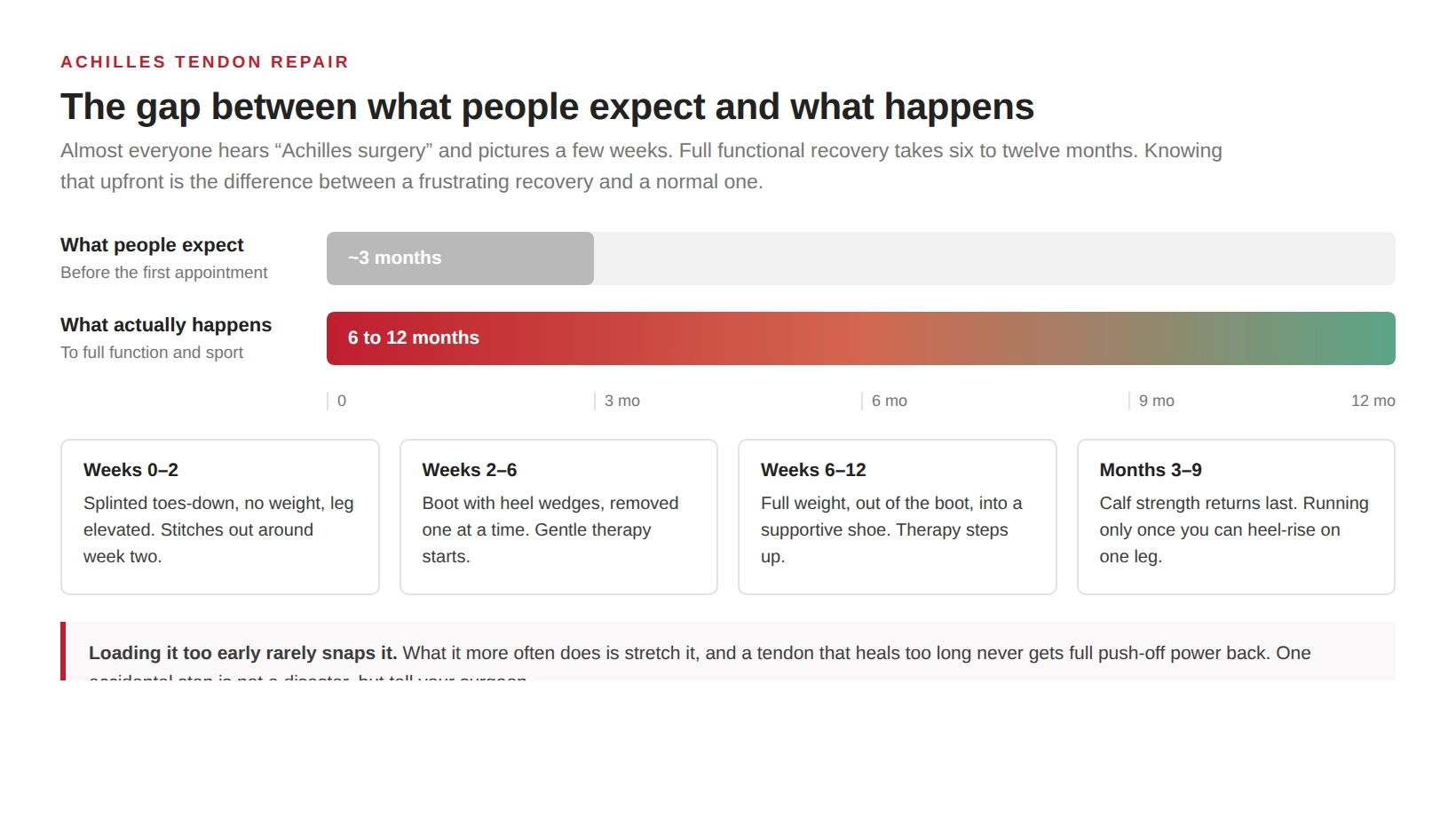
Full recovery from Achilles tendon surgery takes six to twelve months. Not six to twelve weeks. That gap between what people expect and what actually happens is the single biggest source of frustration in this recovery.
The good news is that the early months move faster than the headline number suggests. Most people are out of the boot around three months and back to normal daily life well before they’re back to sport.
Weeks 0 to 2: immobilized and elevated
Your foot is splinted or casted with the toes pointed downward, which takes tension off the repair while it starts to heal. No weight goes through the leg.
Elevation is the main job in these two weeks. Above the level of your heart, most of the day. Swelling here slows everything that follows and makes the incision harder to heal.
Stitches usually come out around the two week mark, once the incision has closed.
Weeks 2 to 6: into a boot, and moving a little
You transition into a removable boot, usually with heel wedges that keep the foot angled downward. Those wedges get removed one at a time over the following weeks, gradually bringing the foot back toward neutral and slowly lengthening the tendon back to normal.
Gentle physical therapy generally starts here, and partial weight-bearing often does too. This is also where people start feeling well enough to be dangerous.
What happens if you put weight on it too soon
This is the question people are most afraid to ask, so here’s a straight answer.
A repaired Achilles is strongest at the two ends and weakest at the repair itself for the first several weeks. Loading it too early doesn’t usually snap it outright. What it more often does is stretch it, and a tendon that heals a centimeter too long never generates full push-off power again. You end up with a calf that won’t get strong and difficulty rising onto that toe.
One accidental step is not a catastrophe. Tell your surgeon it happened rather than hoping it was fine. Repeatedly cheating on the protocol is the thing that costs you.
Why the Achilles takes longer than other injuries
Patients often ask why a tendon repair takes longer to come back than a broken bone. It’s a fair question and the answer is structural.
Bone has a rich blood supply and rebuilds itself aggressively. The Achilles has comparatively poor blood flow, particularly in the stretch a few centimeters above the heel bone where most ruptures happen. Less blood means slower healing, and tendon rebuilds its strength over months rather than weeks.
The other half is that the Achilles is asked to do more than almost any other tendon in the body. Every step transmits several times your body weight through it, and a single-leg hop puts considerably more through it than that. A tendon can be healed enough for walking long before it’s healed enough for running, which is why the clearance to return to sport comes so much later than the clearance to stop using the boot.
Nothing accelerates this by much. Nutrition and not smoking help at the margins, and following the rehab protocol matters more than any supplement. Anyone selling you faster tendon healing is selling you something.
Weeks 6 to 12: out of the boot
Full weight-bearing, then out of the boot and into a supportive shoe, often with a small heel lift at first. Physical therapy steps up considerably.
Your calf on that side will be visibly smaller than the other one. That’s the part that takes longest to come back, and it’s the best single measure of how the recovery is really going.
Months 3 to 9: getting strength back
Walking normally comes back first, then stairs, then the ability to rise onto that toe on one leg, which is the milestone most surgeons and therapists actually care about.
Running and jumping wait until the calf has real strength back, typically somewhere between six and nine months, and only with clearance. Going back to sport early is how people rerupture, and a rerupture is a considerably worse problem than the original injury.
Work, and what to tell your employer
Desk work is often possible within two to three weeks if you can get there safely and keep the leg elevated once you arrive. Getting there is usually the harder half, since you probably can’t drive yet.
Work that involves standing, walking, ladders, or driving typically waits until you are out of the boot and steady on the leg, which is commonly three months or more. Manual and safety-critical roles can take longer still.
Tell your employer the realistic timeline early rather than optimistically. Going back too soon and failing is worse for everyone than arranging proper cover from the start.
The practical things nobody mentions
- Sleeping is awkward for the first few weeks. A pillow under the calf rather than under the heel avoids pressure on the incision.
- Showering needs a proper waterproof cover and a seat. Standing on one leg on a wet floor is exactly the fall you can’t afford.
- You’ll be tired. Moving on crutches costs far more energy than walking.
- Driving waits until you’re out of the boot for a right-sided repair, and until you can brake reliably. Confirm it rather than assume.
When to call
- A sudden pop, giving way, or a gap you can feel at the back of the heel
- Calf pain, swelling, or warmth, which can indicate a blood clot
- Redness spreading from the incision, drainage, or fever
- Numbness, or toes that look pale or blue
- An accidental full weight-bearing step, so it can be documented and checked
Common questions about Achilles surgery recovery
How long until I can walk normally?
Most people walk unaided around three months, though the stride isn’t fully normal until the calf strength returns, often closer to six months.
Does resting my foot on the floor count as weight-bearing?
Resting it there while seated generally doesn’t, because you’re not loading the tendon. Pushing off it, standing on it, or using it to steady yourself does. If you’re unsure which instruction you’re under, ask, because this is the most commonly misunderstood part of the whole recovery.
Can I wiggle my toes?
Yes, and you should. Toe movement doesn’t load the repair and it helps with swelling and circulation.
Will it be as strong as before?
Most people get back to their previous activities. A small difference in calf strength and single-leg heel rise height often persists, which matters to competitive athletes and is rarely noticeable in daily life. How closely you follow the rehab makes more difference here than almost anything else.
Is it painful?
The first several days are properly uncomfortable and are managed with medication and elevation. After the first week, most people describe tightness and aching rather than pain. Increasing pain after the first week is a reason to call.
If anything about your recovery doesn’t feel right
Achilles recovery is long, and most of the anxiety in it comes from not knowing whether what you’re feeling is normal. Usually it is, and it takes a minute to say so.
Our surgeons see patients in Oklahoma City and Tulsa, with clinics across Oklahoma. Request an appointment or call the office closest to you.