
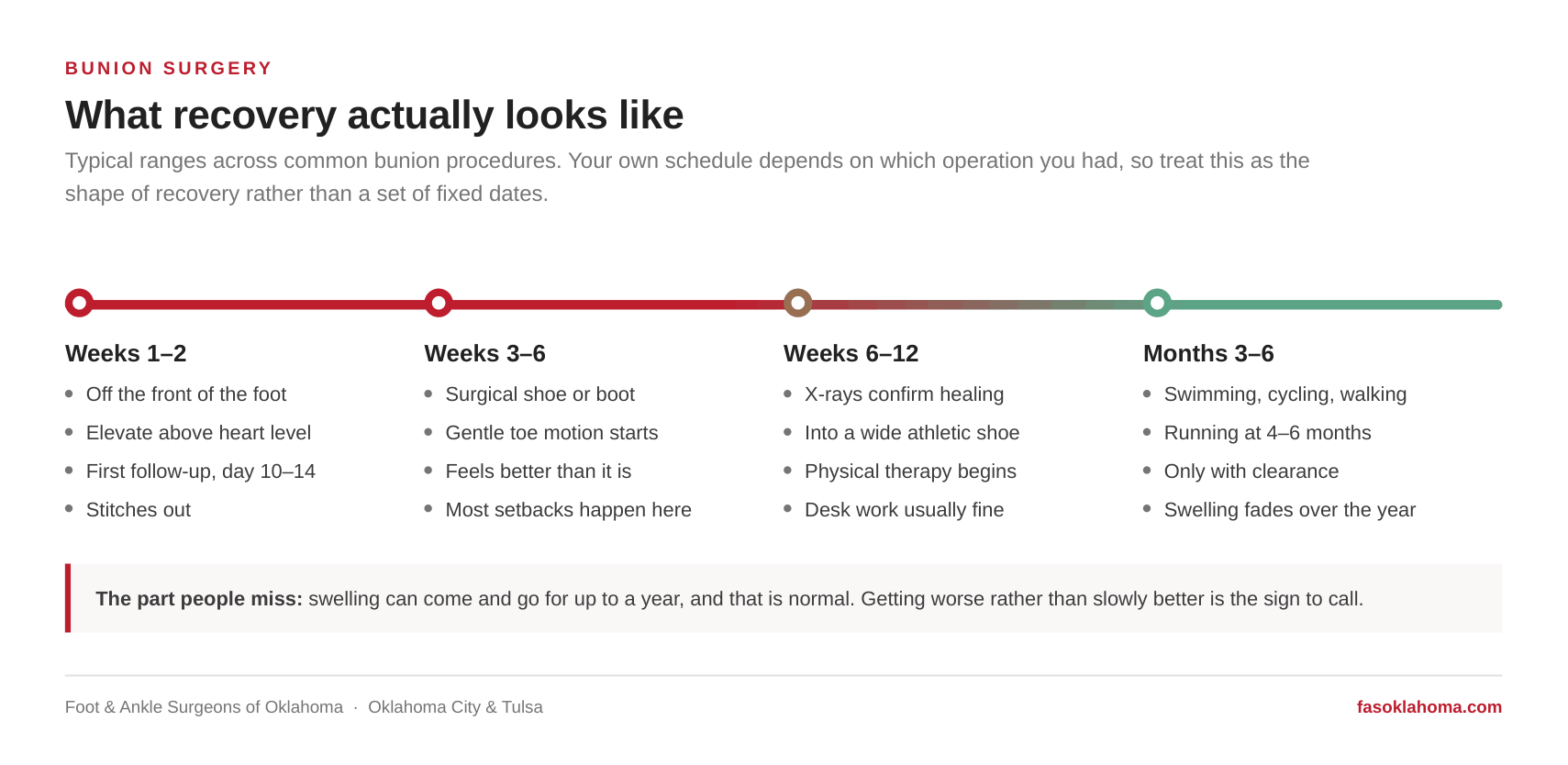
Most people are back in a normal athletic shoe about six weeks after bunion surgery, walking without help by three months, and cleared for running or sports somewhere between four and six months. The bone itself takes six to twelve weeks to knit. Swelling is the part that catches people off guard, because it can come and go for up to a year.
Those are averages across several different operations. What your recovery actually looks like depends on which procedure you had, how severe the bunion was, and how carefully you protect the foot in the first six weeks. Here is how the timeline usually feels from the inside.
Weeks 1 and 2: protect the repair
The first two weeks are about keeping weight off the front of your foot and keeping swelling down. You’ll be in a surgical shoe, a boot, or on a knee scooter depending on what we did.
Elevation does more for you in this window than anything else. Your foot needs to be above the level of your heart for most of the day, not just propped on a footstool. Swelling that gets away from you early makes every stage after it slower and more uncomfortable.
Your first follow-up is usually around day 10 to 14. That’s typically when stitches come out and we get a first look at how the incision is closing.
Pain is real for the first several days and then drops off quickly for most people. If yours is climbing instead of easing after day three or four, call us.
Weeks 3 to 6: the boot phase
By week three the sharp pain is usually gone and the frustration sets in. You feel better than you’re allowed to move.
Depending on the procedure, you’ll either stay off the forefoot or start putting weight through your heel in a surgical sandal or boot. Gentle toe motion usually starts somewhere in here, because a big toe joint that doesn’t move stiffens up, and stiffness is harder to undo later than swelling is.
This is where people get themselves in trouble. The foot feels good enough to cheat on and the bone isn’t ready yet. Cheating between weeks three and six is the most common reason a recovery gets extended.
Weeks 6 to 12: back into a real shoe
Around six weeks we take X-rays to confirm the bone is healing where it should be. If it is, most people move out of the boot and into a wide, supportive athletic shoe.
Your foot won’t fit your old shoes yet. That’s normal. Swelling is still there and will be for months. Wide, soft, laced shoes with room across the toes are what you want. Narrow or dressy shoes are not, and pushing that too early is a reliable way to end up with a painful, stiff toe.
Physical therapy often starts in this window. The goals are motion in the big toe and getting your walking pattern back to normal, since a couple of months of limping teaches your body some habits it needs to unlearn.
Work is the question we get asked about most, and the answer depends entirely on the job. A desk job with the option to elevate is often manageable within one to two weeks. A job that keeps you standing, walking, climbing, or wearing safety boots is usually six to twelve weeks. Tell your surgeon what your day actually involves before surgery, because the answer changes the plan and it’s easier to arrange cover in advance than to negotiate it from home in week two.
Months 3 to 6: back to what you actually want to do
Low-impact activity returns first. Swimming, cycling, and flat walks are usually fine well before running is.
Running, jumping, and court sports generally wait until four to six months, and until your surgeon clears you. A bone can look healed on an X-ray while the joint still isn’t ready to take impact.
Puffiness at the end of a long day can hang around for six months to a year. It’s irritating and it’s normal. If it’s getting worse instead of slowly better, call us.
Why do recovery times vary so much?
Because bunion surgery isn’t one operation.
A traditional bunionectomy corrects the bone near the front of the foot. A Lapiplasty procedure corrects the unstable joint further back, where a lot of bunions actually start, and it’s designed to let people bear weight sooner. Minimally invasive techniques use smaller incisions and often mean less swelling early on.
Each one comes with its own weight-bearing schedule, and that schedule drives how the whole recovery feels. When one source says six weeks and another says four months, both can be accurate. They’re describing different operations and different milestones.
Which operation makes sense for you depends on the shape and severity of the bunion, and that’s a conversation to have before surgery, not after. Our bunion and hammertoe page covers how we approach that decision.
What slows recovery down
- Walking on the foot before you’ve been cleared for it
- Letting swelling run unchecked in the first two weeks
- Smoking, which measurably slows bone healing
- Diabetes or circulation problems, which call for closer monitoring
- Going back into narrow shoes too early
- Skipping the follow-up X-rays that confirm the bone is healing
When to call us instead of waiting
Some things shouldn’t wait for your next scheduled visit. Call if you notice:
- Pain that’s increasing after the first few days instead of easing
- Redness spreading away from the incision, or drainage that’s thick, cloudy, or foul-smelling
- A fever
- Calf pain, calf swelling, or new shortness of breath
- Numbness, or a foot that looks pale and feels cold
- A pop or a visible change in the toe after a stumble
Common questions about bunion surgery recovery
How long after bunion surgery can I walk normally?
Most people walk without crutches, a scooter, or a boot by roughly six to eight weeks, and walk without thinking about it by three months. Distance and speed come back gradually after that.
How painful is bunion surgery recovery?
The first three to five days are the hardest, and they’re managed with medication, ice, and elevation. After the first week, most people describe it as soreness and stiffness rather than pain. Pain that increases after the first week is a reason to call, not a normal stage.
How long do I stay off my feet after bunion surgery?
It depends on the procedure. Some corrections keep you off the forefoot for six weeks. Others allow protected weight through the heel within days. Your surgeon will give you a specific schedule, and that schedule matters more than any general answer you’ll read online.
Will my shoe size change?
Usually not. Your foot may be narrower once the bump is corrected, and swelling can make shoes feel tight for months, but the underlying length rarely changes.
When can I go back to work?
A seated job with room to elevate the foot is often possible within one to two weeks. Work that keeps you on your feet typically waits six to twelve weeks, and jobs requiring steel-toe or safety footwear can take longer, since those shoes don’t accommodate a swollen foot. Ask before you schedule surgery rather than after.
Why do people put off bunion surgery?
Almost always the recovery, not the operation. People hear “months” and picture months of doing nothing. In practice the restrictive part is the first six weeks, and most of what follows is a gradual return to normal rather than time on the couch. Waiting has its own cost, since bunions don’t correct themselves and a more severe deformity is a bigger operation.
Talk to us before you commit to anything
If you’re weighing bunion surgery, or you’re mid-recovery and something doesn’t feel right, we’d rather hear from you early.
Our surgeons see patients in Oklahoma City and Tulsa. Request an appointment and we’ll get you scheduled.