A bunion cannot be shrunk, reversed, or dissolved without surgery. It is not a growth or a deposit. It is a bone that has drifted out of position, and no oil, soak, exercise, or device moves a bone back.
That is the honest starting point, and it matters, because a great deal of what is sold and shared on this subject depends on people not knowing it. What non-surgical treatment can do is real and it matters: it relieves pain, it slows the progression, and it can keep you comfortable for years. It just does not change the shape of the bone.
What a bunion actually is
The medical name is hallux valgus. The joint at the base of the big toe drifts outward while the toe itself angles inward toward the second toe. The bump on the side of your foot is not extra bone that has grown. It is the head of the first metatarsal, now sitting where it was never meant to sit.
In many feet the drift starts further back, at the joint where that metatarsal meets the midfoot. When that joint is loose, the bone in front of it has room to wander. This is why bunions tend to progress, and why they do not spontaneously improve.
Understanding this makes the rest of the page straightforward. Anything that claims to shrink the bump is claiming to move a bone, and topical products do not move bones.
What does not work
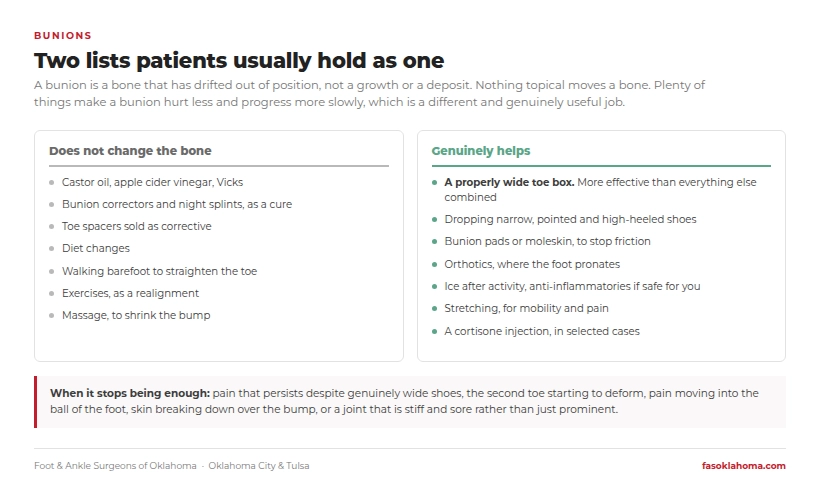
Castor oil, apple cider vinegar, and Vicks
These are the three most searched home remedies for bunions and none of them affects bone position. Massaging any oil into a sore joint feels pleasant and briefly reduces the sensation of stiffness, which is probably why the belief persists. The bump is the same size afterwards.
Bunion correctors and toe straighteners, as a cure
A splint that holds the toe straight while you sleep can feel good and can ease pressure. It does not remodel the joint. The moment it comes off, the toe returns to its position, because the alignment problem is in the bone and the ligaments, not in a habit the toe can be retrained out of.
This distinction matters for children and adolescents slightly differently, and it is one of the few areas where early intervention has more to offer, so a young person with a developing bunion should be assessed rather than managed at home.
Diet changes
Bunions are a structural problem, not an inflammatory or dietary one. There is no food that causes them and none that resolves them. If you also have gout, that is a separate condition affecting the same joint and diet does matter there, which is likely where the crossover belief comes from.
Walking barefoot to fix the deformity
Going barefoot avoids the shoe pressure that aggravates a bunion, so it often feels better in the short term. It does not correct alignment, and on hard floors it removes support that some feet need. Comfortable is not the same as corrective.
Exercises, as a correction
Toe stretches, towel scrunches, and strengthening work help with mobility, balance, and pain. They are useful. They are not going to straighten the toe, and any source promising realignment from exercise is overstating what muscles can do against a bone position.
What actually helps
None of this is exciting, and all of it works better than the remedies above.
- Footwear with a properly wide toe box. This is the single most effective non-surgical change. A shoe that stops squeezing the toe removes the force driving the deformity and most of the day-to-day pain.
- Getting rid of narrow and pointed shoes and high heels, which concentrate load onto exactly the wrong part of the foot.
- Bunion pads or moleskin over the bump to stop friction. Symptom relief, and effective at it.
- Toe spacers for comfort, used with realistic expectations about what they do.
- Orthotics, particularly where the foot flattens or rolls inward, which can reduce the force pushing the metatarsal outward. Custom devices make more sense than over-the-counter ones when the mechanics are the problem.
- Ice after activity, and anti-inflammatory medication if your physician says it is safe for you.
- Activity modification rather than activity avoidance. Staying active is good for you; grinding out long days in the wrong shoes is not.
- A cortisone injection in selected cases, which can settle an inflamed joint. It treats the symptom and does not alter the deformity.
Do bunions always get worse
Most progress over years, some quickly and some barely at all. What drives progression is the underlying mechanics of your foot rather than anything you did, though narrow shoes accelerate it. Bunions do not correct themselves and they do not stay the same forever in most people.
They also do not have to be fixed simply because they exist. A bunion that does not hurt, does not limit your shoes, and is not deforming your other toes is one to monitor, not operate on.
Who gets bunions
The largest factor is inherited foot structure. If your parents had bunions you are considerably more likely to. Footwear is a genuine contributor but it is an accelerant rather than the root cause, which is why people who have never worn a narrow shoe still develop them.
Other contributors include flat feet or excessive pronation, joint hypermobility, inflammatory arthritis such as rheumatoid arthritis, and neuromuscular conditions. Women are affected more often than men, which is partly structural and partly footwear.
When non-surgical management stops being enough
This is the point most people are actually trying to work out. The reasonable triggers for a surgical conversation are these.
- Pain that persists despite properly wide shoes. Once footwear has been fixed and it still hurts, you have exhausted the most effective non-surgical measure available.
- The deformity is affecting the other toes, causing a hammertoe on the second toe, or the toes are beginning to overlap.
- Pain has moved into the ball of the foot, which suggests load is being transferred off the big toe onto bones that were not designed to carry it.
- You are avoiding activities you want to do, or your shoe choice is dictated entirely by the bunion.
- Skin is breaking down over the bump, or there is recurrent irritation and callus.
- There is stiffness and pain within the joint itself rather than just at the bump, which may indicate arthritis and changes what the right operation is.
Appearance alone is a reason people ask, and it deserves a straight answer: surgery for cosmetic reasons carries the same recovery as surgery for pain, and insurance generally does not cover it. Most surgeons will talk you through that straight rather than talk you into it.
If you reach that point, our bunion and hammertoe page covers how we assess which correction fits which foot.
Common questions about treating bunions without surgery
Can bunions be reversed naturally?
No. The bump is a bone in the wrong position, and no topical treatment, exercise, or device returns it to alignment. Non-surgical treatment manages symptoms and slows progression, which is a useful thing to do, but it is not reversal.
What is the root cause of bunions?
Inherited foot structure in most cases, particularly a loose joint at the base of the first metatarsal or a foot that pronates heavily. Narrow footwear accelerates the process rather than starting it.
What do podiatrists recommend for bunions?
Wide footwear first, because it does more than everything else combined. Then padding, orthotics if the mechanics warrant them, activity modification, ice and anti-inflammatories for flares, and surgical assessment once those stop controlling the pain.
Are bunions for life?
Untreated, yes. The deformity does not resolve on its own. Whether it needs correcting depends on symptoms rather than on its existence.
Is it good to massage a bunion?
Massage can ease stiffness and feels good on a sore joint. It will not change the alignment. There is no harm in it as long as the joint is not acutely inflamed.
Is walking a lot bad for bunions?
Walking in appropriate shoes is fine and generally good for you. Walking long distances in narrow shoes is what causes trouble. The shoe matters far more than the mileage.
What happens if I do not fix my bunion?
For many people, a slow increase in the deformity with manageable symptoms. For some, progression that crowds the second toe, transfers pain to the ball of the foot, or eventually brings arthritis into the joint. A more severe bunion is a bigger operation than a moderate one, which is the practical argument against waiting indefinitely once it is actually bothering you.
Do toe spacers work?
They work as comfort devices and can reduce rubbing between the toes. They do not correct the deformity, and any that are sold on that promise are overselling.
Get an honest assessment before you spend money on the internet
If you have a painful bunion, the most useful thing you can do is have someone look at it and tell you what stage it is at and what is realistic. That is one appointment, and it saves a lot of money on products that were never going to work.
Our surgeons see patients in Oklahoma City and Tulsa, with clinics across Oklahoma. Request an appointment or call the office closest to you.