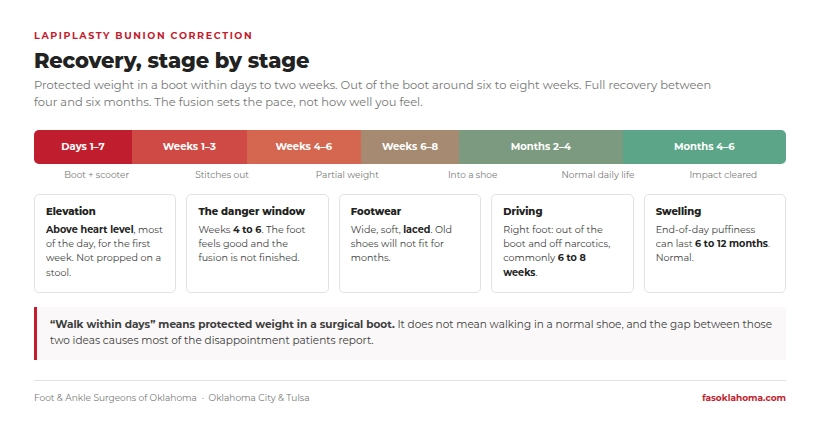
Most Lapiplasty patients put protected weight through a surgical boot within the first few days to two weeks, move into a normal supportive shoe somewhere around six to eight weeks, and reach full recovery between four and six months. The fusion is the thing being waited on. Bone has to bridge across the joint, and that timeline is set by biology rather than by how good you feel.
The stage-by-stage version is below, followed by the practical questions people actually search for at eleven at night in week two.
Days 1 to 7: elevation is the whole job
You will be in a surgical boot and using a knee scooter, crutches, or a walker. Pain peaks in the first three to five days and then falls off for most people.
Your foot needs to be above the level of your heart for most of the day. Not propped on an ottoman, actually above heart level, which usually means lying down with pillows. Swelling that gets ahead of you in this week makes every later stage slower.
Ice as directed, keep the dressing dry, and do not judge the result by what the foot looks like. It will be swollen and bruised, and bruising can track down into the toes and around the ankle.
Weeks 1 to 3: the first look, and the stitches
Your first follow-up is usually somewhere between day 10 and day 14. Stitches or sutures typically come out around the two week mark and you will normally have an X-ray to check alignment.
Many patients are cleared for partial weight through the boot in this window. Whether you are, and how much, depends on your surgeon and on what your bone looked like at surgery. The boot is doing real work here, so wear it as instructed rather than as a suggestion.
Weeks 4 to 6: feeling better than you are allowed to move
Pain and swelling drop noticeably. Most people are steadier in the boot and stop needing the scooter or crutches indoors.
This is where recoveries get extended. The foot feels good and the fusion is not finished. A fusion that gets loaded before it unites can fail to knit, and a nonunion is a bigger problem to solve than the original bunion was. The restriction in these weeks is not caution for its own sake.
Weeks 6 to 8: out of the boot, into a real shoe
Around six to eight weeks you will have X-rays to confirm the fusion is healing. If it is, most people transition out of the boot into a wide, supportive, laced athletic shoe.
Your foot will not fit your old shoes. Swelling is still present and will be for months. Wide, soft, and laced is what works. Narrow or dressy shoes this early are a reliable way to end up with a stiff, painful toe.
Physical therapy often starts around here, aimed at motion in the big toe, ankle mobility, and unlearning the walking pattern two months in a boot has taught you.
Months 2 to 4: normal life comes back
Daily activity, desk work, driving once you are out of the boot and off narcotic medication, and low-impact exercise like a stationary bike or swimming. Walking distance builds gradually rather than all at once.
Months 4 to 6: impact, and the last of the swelling
Running, court sports, and anything with jumping generally wait until four to six months and until your surgeon clears you. A fusion can look solid on an X-ray while the surrounding soft tissue is still catching up.
End-of-day puffiness can persist for six months to a year. That is normal. Swelling that is getting worse rather than slowly better is a reason to call.
Why Lapiplasty recovery is not the same as other bunion surgery
A traditional bunionectomy heals a cut in a bone. Lapiplasty heals a fusion across a joint. Both take roughly six to twelve weeks of bone healing, but the consequences of loading them early are different, and the hardware is different.
The reason you may have read that Lapiplasty lets you walk sooner is that the plates are designed to be stable enough for protected weight early. Protected weight in a boot is not the same as walking normally, and the difference between those two ideas causes most of the disappointment patients report.
Our bunion surgery recovery guide covers the general week-by-week picture across all the procedures if you are comparing.
The practical questions nobody covers
How do I shower?
You need a proper waterproof cover that seals above the calf, and a shower seat or bench. Standing on one leg on a wet surface is how people fall in week two. Sponge baths are the fallback until the incision is fully closed and you have been cleared.
How do I sleep?
On your back with the foot elevated on pillows for the first couple of weeks. A wedge pillow or a stack that holds the foot above the heart works better than a single pillow that slides off overnight. Side sleeping usually becomes comfortable again once the acute swelling settles.
Do I sleep in the boot?
That depends on your surgeon’s instruction. Some ask for the boot at night early on to protect against rolling the foot; others allow it off once you are past the first weeks. Ask directly rather than guessing, because the two instructions look identical from the outside and are not.
How do I use the bathroom?
A knee scooter is easier than crutches in a small bathroom, and most people find a raised seat or a grab bar helps in the first two weeks. Arrange this before surgery rather than discovering it the first night home.
Can I wiggle my toes?
Yes, and gentle toe movement is usually encouraged. It helps with swelling and circulation and it does not load the fusion. Ask your surgeon about active big-toe motion specifically, since that is the one they will want to control.
Why does my foot feel tight?
Swelling, and the natural stiffness of a foot that has been immobilized. Tightness that eases as the day goes on is expected. Tightness with increasing pain, spreading redness, or numbness is not, and that is a call rather than a wait.
What do I need at home before surgery?
- A knee scooter or crutches, arranged in advance rather than the day of
- A waterproof shower cover and a shower seat
- Pillows or a wedge that hold the foot above heart level
- Ice packs, and a way to refill them without standing
- Food you can prepare sitting down, or meals prepared ahead
- A wide, laced shoe ready for the six to eight week transition
Common questions about Lapiplasty recovery
How long will my foot hurt after Lapiplasty?
Significant pain is usually the first three to five days and is managed with medication, ice, and elevation. After the first week most people describe soreness and stiffness rather than pain. Discomfort at the end of a long day can continue for several months. Pain that increases after the first week is a reason to call, not a stage.
How long should I stay off my feet after Lapiplasty?
You will usually be off the foot entirely for the first days, then in protected weight-bearing in a boot for roughly six to eight weeks. The specific schedule comes from your surgeon and matters more than any general answer, because it depends on the fixation and on your bone.
When can I walk barefoot?
Usually not until you are well out of the boot and cleared, commonly around three months. Barefoot walking removes all the support the shoe is providing and puts the load straight through the correction.
Do I go up a shoe size after Lapiplasty?
Length rarely changes. The foot is often narrower once the deformity is corrected. Shoes feel tight for months because of swelling, which is not a change in size.
When can I drive?
After a right-foot procedure, generally once you are out of the boot and off narcotic pain medication, which is commonly six to eight weeks. Left-foot surgery in an automatic car is often sooner. Check with your insurer as well as your surgeon.
When can I go back to work?
A seated job with room to elevate is often possible within one to two weeks. Work that keeps you standing or walking typically waits six to twelve weeks, and jobs needing safety boots can take longer because those shoes do not fit a swollen foot. Ask before you schedule surgery, not after.
Will the plates have to come out?
Usually not. A minority of patients have hardware removed later, most often because a plate sits under thin skin on the top of the foot and irritates against shoes. That is a straightforward second procedure done only after the fusion is solid.
When to call us instead of waiting
- Pain that is increasing after the first few days instead of easing
- Redness spreading from the incision, or drainage that is thick, cloudy, or foul-smelling
- A fever over 100.4°F
- Calf pain, calf swelling, or new shortness of breath
- Numbness, or toes that look pale, blue, or feel cold
- A pop, a sudden change in the position of the toe, or a fall onto the foot
Ask us anything that is worrying you
Most of the anxiety in a Lapiplasty recovery comes from not knowing whether what you are feeling is normal. It usually is, and the times it is not are the times we want to hear from you early.
Our surgeons see patients in Oklahoma City and Tulsa, with clinics across Oklahoma. Request an appointment or call the office closest to you.