
Traditional bunion surgery cuts and shifts the bone near the front of the foot to straighten the toe. Lapiplasty works further back, rotating the whole misaligned bone and fusing the unstable joint at its base with titanium plates. Both correct a bunion. They suit different feet, and the honest answer to which is better is that it depends on where your bunion is coming from.
Most of what patients read on this comparison is published by the company that makes the Lapiplasty system or by practices that have invested in it. That material is accurate about the procedure and incomplete about who should not have it. This page covers both halves.
What the two operations actually do differently
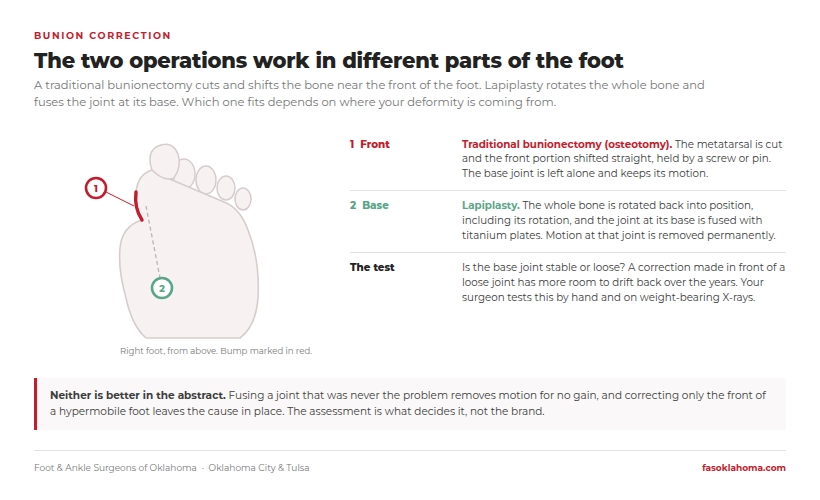
A traditional bunionectomy, usually an osteotomy, makes a cut in the metatarsal bone behind the big toe and shifts the front portion over into a straighter position. A screw or pin holds it while it heals. The joint at the base of the metatarsal is left alone.
Lapiplasty is a version of the Lapidus procedure. Instead of cutting the bone in its middle, the surgeon rotates the entire metatarsal back into position, including its rotation, and then fuses the joint at the base where the metatarsal meets the midfoot. Instrumentation guides the alignment, and plates hold the fusion.
The difference that matters clinically is the joint at the base. In some feet that joint is stable, and correcting the bone further forward holds well. In other feet that joint is loose, and a correction made in front of a loose joint has more opportunity to drift back over the years. Assessing that joint is a large part of what your surgeon is doing when they examine your foot and read your weight-bearing X-rays.
Who tends to be a good candidate for Lapiplasty
- A bunion with a visibly rotated big toe, where the nail turns inward rather than facing straight up
- Hypermobility at the joint at the base of the first metatarsal, which your surgeon tests by hand
- A moderate to severe deformity on weight-bearing X-rays
- A bunion that has already returned after an earlier correction
- Enough bone density to hold a fusion, and no active infection in the foot
Who is usually not a candidate
This is the part the marketing material tends to leave out, and it is the part patients most want to know before they take a day off work for a consultation.
- A mild bunion with a stable base joint. Fusing a joint that was never the problem removes motion for no gain.
- Significant arthritis in the big toe joint itself. That is a different problem and a fusion further back will not resolve the pain.
- Poorly controlled diabetes, active smoking, or circulation problems, all of which reduce the odds of a fusion healing. Smoking in particular is a common reason a surgeon will decline to perform a fusion until you stop.
- Skeletal immaturity. Growth plates need to be closed.
- Anyone who cannot realistically stay protected during the early weeks. A fusion that is loaded too early can fail to unite, and that is a harder problem to fix than the original bunion.
What the recurrence numbers mean, and what they do not
You will see a recurrence rate under three percent quoted for Lapiplasty and rates as high as thirty percent quoted for traditional surgery. Those figures come largely from manufacturer-sponsored studies and from follow-up periods that are shorter than the decades a bunion has to stay corrected.
The comparison is also not like for like. Traditional recurrence figures are pooled across many different osteotomies performed on many different severities of deformity, including severe bunions that were poor candidates for that technique in the first place. A well-selected osteotomy on a stable foot performs considerably better than the pooled number suggests.
The reasonable way to read all of it: recurrence is driven more by whether the correction addressed the actual source of the deformity than by the brand of the procedure. That is an argument for a careful assessment, not automatically for one operation.
The scar
Lapiplasty leaves a longer incision than most traditional bunionectomies, generally along the top or inside of the foot, because the surgeon needs access to the joint at the base. Expect several centimeters rather than a small mark. It fades substantially over the first year and sits where a shoe does not usually rub.
Minimally invasive techniques leave the smallest scars of the three approaches. If scar appearance is your main concern, say so at your consultation, because it is a legitimate factor in the decision and it changes which options are on the table.
Cost and insurance
Bunion surgery is generally covered by insurance when the bunion causes pain or interferes with function, which is the case for most people who reach the point of considering surgery. Coverage is far less likely when the reason is appearance alone.
Lapiplasty typically carries a higher facility and implant cost than a standard osteotomy. What you pay out of pocket depends on your deductible, your coinsurance, and whether the surgery centre is in network, rather than on the procedure name. Our office can run a benefits check before you schedule so you have a real number instead of an estimate.
What the negative reviews get right
Search for Lapiplasty reviews and you will find unhappy patients alongside the success stories. The recurring themes deserve to be taken seriously.
- Recovery took longer than expected. A fusion has to knit, and that takes as long as it takes regardless of how early you were allowed to put weight on the boot.
- Swelling lasted for months. This is true of every bunion correction and it is the single most underestimated part of recovery.
- Hardware irritation. Plates sit under thin skin on the top of the foot, and a minority of patients have them removed later once the fusion is solid.
- Stiffness. Fusing a joint removes motion at that joint by design. In most feet the loss is not noticeable in daily walking, but it is permanent and you should understand it before you consent.
- Expectations set by marketing. “Walk within days” means protected weight in a surgical boot, not walking in a normal shoe.
None of these make Lapiplasty a bad operation. They describe a real fusion with a real recovery, which is what it is.
So which one should you have
That decision comes out of an examination and weight-bearing X-rays, not out of an article. What you can do before the appointment is arrive with the right questions: is my base joint hypermobile, is my toe rotated, how severe is my deformity in degrees, and what happens to your recommendation if I turn out to be a borderline case.
A surgeon who performs both operations can answer those without a stake in the answer. A practice that only offers one will tend to recommend the one it offers.
Our bunion and hammertoe page covers how we approach that assessment.
Common questions about Lapiplasty and traditional bunion surgery
What are the disadvantages of Lapiplasty?
A permanent loss of motion at the fused joint, a longer incision and scar, a higher implant cost, and a recovery that depends on a fusion healing rather than a bone cut healing. In the right foot these are acceptable trade-offs for a more complete correction. In the wrong foot they are costs with no matching benefit.
Is Lapiplasty better than traditional bunion surgery?
It is better suited to bunions that come from an unstable base joint or that involve significant rotation of the toe. For a mild, stable bunion, a traditional osteotomy is a smaller operation that preserves motion and generally recovers faster. Neither is better in the abstract.
Who is not a candidate for Lapiplasty?
People with a mild, stable deformity, significant arthritis in the big toe joint itself, poorly controlled diabetes, active smoking, or circulation problems that make bone healing unreliable. Growth plates also need to be closed.
What is the most successful type of bunion surgery?
The one matched to your deformity. Success in bunion surgery tracks with correct procedure selection far more closely than with any particular technique, which is why two people can have opposite experiences with the same operation.
Should a 70 year old have bunion surgery?
Age by itself is not a barrier. Bone quality, circulation, diabetes control, and how much the bunion is limiting you matter much more than the number. Plenty of people in their seventies do well. The assessment is individual.
When is it too late to have bunion surgery?
There is no cut-off, but bunions do get harder to correct as they progress, and a severe deformity is a bigger operation than a moderate one. If arthritis has set into the big toe joint, the conversation shifts from correcting the bunion to treating the joint, which is a different procedure.
Does your shoe size change after bunion surgery?
Length rarely changes. Width often improves once the bump is corrected, so shoes may fit better across the toes. Swelling makes everything feel tight for months, which is not a change in size.
Come in and get a straight answer
If you are trying to choose between procedures, the useful next step is an examination and a weight-bearing X-ray. That takes one visit and it replaces a lot of guessing.
Our surgeons see patients in Oklahoma City and Tulsa, with clinics across Oklahoma. Request an appointment or call the office closest to you.