
For most foot and ankle problems, either specialty can help you, and the more useful question is not which letters follow the doctor’s name but how much of their practice is foot and ankle work, what they are board certified in, and how often they perform the specific procedure you might need.
That said, the two training routes really are different, and the differences matter in some situations and not in others. What follows is the honest version, including where the common summaries get it wrong.
The two training paths
Podiatric foot and ankle surgeon (DPM)
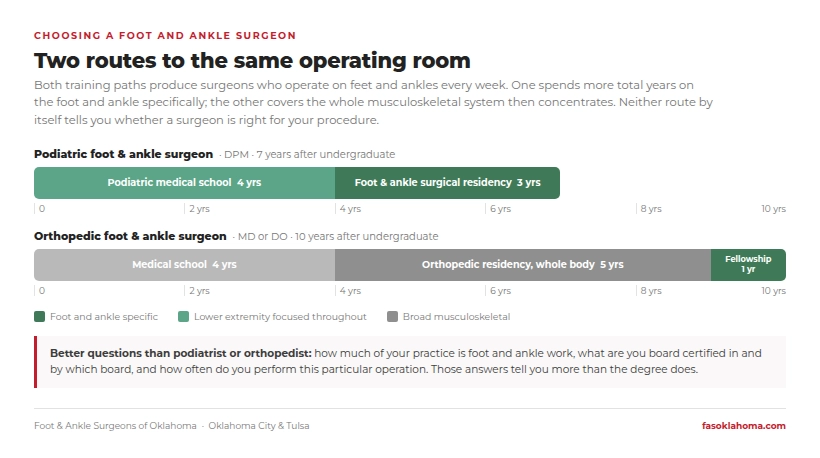
A Doctor of Podiatric Medicine completes four years of podiatric medical school, which covers general medical sciences with the lower extremity as the specialist focus throughout, followed by a three-year hospital-based surgical residency. That residency is spent almost entirely on the foot and ankle.
Surgical certification comes through the American Board of Foot and Ankle Surgery, which certifies separately in Foot Surgery and in Reconstructive Rearfoot and Ankle Surgery. That second certification is the one that matters for ankle-level work, and it is not automatic. Some podiatric surgeons also complete an additional fellowship.
Orthopedic foot and ankle surgeon (MD or DO)
An orthopedic surgeon completes four years of medical school, then a five-year orthopedic residency covering the entire musculoskeletal system, from shoulders to spine to knees. A surgeon who specializes in the foot and ankle then completes a further one-year fellowship in that area.
Certification is through the American Board of Orthopaedic Surgery. There is no separate foot and ankle board certificate, so the fellowship and the surgeon’s actual case mix are what tell you they subspecialize.
What that adds up to
A podiatric surgeon has spent more total years focused on the foot and ankle specifically. An orthopedic foot and ankle surgeon has broader musculoskeletal training with a concentrated year in the area. Both routes produce surgeons who operate on feet and ankles competently every week, and neither route by itself tells you whether a particular surgeon is right for a particular operation.
Where the usual summary is wrong
You will read that podiatrists handle nails, calluses, orthotics and mild bunions, while complex reconstruction, major trauma and ankle replacement belong to orthopedic surgeons. That description is out of date and it describes podiatry as it was several decades ago.
Podiatric surgeons certified in reconstructive rearfoot and ankle surgery routinely perform ankle fracture fixation, flatfoot and cavus foot reconstruction, ankle fusion, and, with the appropriate training and credentials, total ankle replacement. Meanwhile plenty of orthopedic foot and ankle surgeons manage the conservative and routine end of the spectrum, including orthotics.
The two scopes overlap far more than the summary suggests. What varies is the individual surgeon, and one genuine structural difference described below.
The one difference that is real: scope of practice varies by state
Podiatric scope of practice is set by state law, and states differ in how far up the leg a DPM may operate. Some states permit ankle surgery and procedures on the lower leg; others define the scope more narrowly. Orthopedic surgeons have no such anatomical boundary.
In practice this rarely limits a patient, because a podiatric surgeon working at the ankle in a state that permits it is doing so lawfully and with the certification to match. It explains why the two professions are described differently in different places, and it is a fair thing to ask about directly.
When the choice actually matters
Situations where either is fine
- Bunions, hammertoes, and most forefoot surgery
- Plantar fasciitis and heel pain
- Ingrown toenails, skin and nail problems, and routine foot care
- Orthotics and biomechanical assessment
- Most ankle fractures
- Achilles tendon problems
- Diabetic foot care and wound management
Situations where you should look at the individual surgeon carefully
- Total ankle replacement. Volume matters a great deal here regardless of the surgeon’s training route. Ask how many they perform in a year.
- Complex deformity correction and revision surgery, where an earlier operation has failed.
- Severe trauma involving multiple bones or the joint surface.
- Charcot reconstruction and limb salvage.
Situations that point elsewhere entirely
- Foot or ankle pain that turns out to be referred from the lower back, which is a spine problem.
- Symptoms suggesting a systemic condition, such as inflammatory arthritis or a circulation problem, where rheumatology or vascular input is needed alongside foot care.
- Peripheral neuropathy with no structural foot problem, which may need neurology or diabetes management as much as podiatry.
Better questions than podiatrist or orthopedist
If you are choosing a surgeon for a specific problem, these questions will tell you more than the credential will.
- How much of your practice is foot and ankle work?
- What are you board certified in, and by which board?
- How often do you perform this particular operation?
- What are the alternatives to surgery in my case, and what happens if I wait?
- What does your recovery protocol look like, and who manages the rehabilitation?
- What is your complication rate for this procedure, and what do you do when it happens?
A surgeon who answers these plainly is giving you more useful information than any comparison article can. A surgeon who is evasive about volume on a low-frequency procedure has told you something too.
What about referrals and insurance
Both specialties are covered by essentially all insurance plans for medically necessary foot and ankle care. Some plans require a referral from a primary care physician for either. If you have an HMO, check whether your plan requires a referral before booking, since that is far more likely to affect your options than the choice of specialty.
If your primary care physician refers you somewhere, it is reasonable to ask why that particular practice, and equally reasonable to seek a second opinion before a significant operation. Second opinions are routine in surgery and no reasonable surgeon takes offence at one.
Common questions
Should I go to an orthopedic surgeon or a podiatrist?
For most foot and ankle problems, either will serve you well, and the surgeon’s subspecialty focus and case volume matter more than the training route. For high-complexity procedures such as total ankle replacement or revision reconstruction, choose on the individual surgeon’s experience with that specific operation.
What type of doctor is best for foot surgery?
A surgeon who operates on feet regularly, holds surgical board certification relevant to the procedure, and performs your operation often. That describes both podiatric foot and ankle surgeons and fellowship-trained orthopedic foot and ankle surgeons.
Is a podiatrist a real doctor?
Yes. A DPM is a physician-level degree requiring four years of professional school after an undergraduate degree, followed by a three-year hospital surgical residency. Podiatric surgeons hold hospital privileges, prescribe medication, and perform surgery. The degree differs from an MD in its focus, not in whether it is a doctorate.
Can a podiatrist treat a foot fracture?
Yes, including surgically. Foot fractures are core podiatric practice. Ankle fractures are also routinely managed by podiatric surgeons with the appropriate certification, subject to the scope of practice in that state.
Can a podiatrist perform ankle replacement?
In states whose scope of practice permits ankle surgery, and with the relevant reconstructive rearfoot and ankle certification and training, yes. As with any surgeon, the question to ask is how many they perform rather than which board certified them.
Do I need a referral?
It depends on your insurance rather than on the specialty. Many plans allow you to book directly with either. HMO plans commonly require a referral for both.
Come and see us
If you are not sure who to see, a consultation will tell you what the problem actually is, which is the thing that determines who should treat it. We will tell you if it belongs with someone else.
Our surgeons see patients in Oklahoma City and Tulsa, with clinics across Oklahoma. Request an appointment or call the office closest to you.